How I Create Your Book Cover Art
Full transparency on my AI-assisted design process, your copyright protections, and why this approach delivers exceptional results for your books.
Thank you for considering me for your book cover design. Before we begin working together, I want to be completely transparent about my creative process, the tools I use, and what that means for you and your book. This page answers every question you might have about AI-assisted design, copyright, and your rights as a client.
However we connect and work together, I hold myself to the same professional standards of transparency and quality. These are my personal commitments to every client.
What Tools Do I Use?
I use AI-assisted image generation as one of several tools in my professional design workflow. Specifically, I use advanced AI image generation platforms alongside traditional design software (for compositing, typography, color grading, and layout) to create your book covers.
I want to be upfront about this because transparency is not optional — it's a core value of how I work, and it's a standard I bring to every client relationship.
What Does “AI-Assisted” Actually Mean?
When most people hear “AI-generated art,” they picture someone typing a few words into a box and accepting whatever appears. That is not what I do. Not even close.
Step 1 — I Design Your Cover in Words
Before any image is generated, I write a detailed creative brief — typically 2,000 to 3,000 words — that specifies every element of your cover:
- Character appearance — ethnicity, bone structure, skin tone, eye color, hair, expression, scars, distinguishing features
- Clothing & equipment — materials, construction, damage state, cultural influences, color palette
- Background & setting — specific story locations, architecture, landscape, weather, lighting
- Mood & atmosphere — particle effects, light behavior, color temperature, emotional tone
- Composition — exact placement zones, text-safe areas, depth-of-field specifications
- Typography — font family, exact placement, hex color values, letter-spacing, decorative treatments
Step 2 — I Generate and Select
Using that detailed brief, I generate multiple image candidates. Most don't meet my standards. I select only the outputs that best match the creative vision — often generating dozens of candidates before finding ones that work.
Step 3 — I Refine and Produce
Selected images are then professionally finished:
- Compositing — combining elements from different generations
- Color grading — matching the series vision and print/digital requirements
- Typography — professional text design and placement
- Layout optimization — meeting platform-specific requirements
- Series consistency — unified visual language across all covers
See It in Action — A Real Creative Brief
Below is the actual creative brief I wrote for Book 1: Sunblade Rising from my Aztec Samurai Adventures series, alongside the finished cover it produced. This single brief contains approximately 2,800 words of specific creative direction — hundreds of individual decisions about every visual element.
Each section of the prompt is color-coded so you can see exactly how much detail goes into every aspect of the design.
Creative Brief — Book 1: Sunblade Rising
BOOK 1: SUNBLADE RISING - A BLADE FORGED IN LIGHT
TYPE: Ebook Front Cover (Amazon Kindle + Apple iBooks)
DIMENSIONS: 1600 x 2400 pixels, 300 DPI, sRGB color profile
COMPATIBLE: Amazon Kindle (min 1000x1600, ideal 1600x2400), Apple iBooks (max 1600x2400, max 4M pixels)
A breathtaking ultra-high-resolution photorealistic book cover rendered at 1600x2400 pixels, 300 DPI, in sharp cinematic digital style with advanced volumetric lighting, ray-traced reflections, and subsurface skin scattering. This must look like a $200-million Hollywood movie poster — every surface, every texture, every particle of light rendered with obsessive photographic precision. ABSOLUTELY NO oil painting, NO watercolor, NO painterly brushstrokes, NO soft-focus artistic filters, NO traditional media aesthetic whatsoever. Every pixel must be razor-sharp, hyper-detailed, and cinematically lit.
A breathtakingly gorgeous young woman of indigenous Mesoamerican descent in her early 20s — the kind of beauty that stops armies and starts legends. She is positioned in the lower-right quadrant of the image, her face centered at approximately 65-75% down from the top, offset slightly right of center. She is captured in a moment of devastating power — her jade-obsidian katana raised at a diagonal behind her right shoulder, the blade erupting with blinding golden sunfire that streaks outward in razor-sharp rays...
Her face is the centerpiece of the image and must be rendered with obsessive, magazine-cover-quality photorealism. Her bone structure is exquisite — high, sculpted cheekbones that catch the golden light like polished bronze, a strong elegant jawline that tapers to a slightly rounded chin... Her eyes are absolutely stunning — large, wide-set, and devastatingly expressive. Her irises are deep obsidian-black shot through with golden amber striations that radiate outward from the pupil like fractures in volcanic glass filled with liquid sunlight...
Her hair is long, raven-black, and magnificent — thick and lustrous with a blue-black sheen that catches every available light source. It is styled in elaborate warrior braids — some tight and functional, others looser and decorative. The braids are threaded with turquoise stone beads (each bead individually carved with tiny geometric patterns), small gold rings that catch the light like scattered stars, and thin obsidian pins with jade tips...
She wears layered armor that fuses Mesoamerican ceremonial grandeur with practical samurai-influenced combat design. The primary layer is a chest guard of obsidian-flecked lacquered plates — each plate individually shaped and fitted, the lacquer so polished it reflects the surrounding light like dark mirrors. Gold filigree traces elaborate sun-disc patterns across the chest guard...
Her katana is a masterwork of impossible beauty. The blade is forged from a seamless fusion of volcanic obsidian glass and jade-green steel — the surface rippling with a visible hamon line where the two materials merge, creating a wave pattern that seems to move in the light. The blade is currently BLAZING with golden sunfire — intense, radiant, almost blinding at the edge...
Behind Itzil and slightly out of focus (cinematic depth-of-field), the background depicts the sacred courtyard of the Sun-Blade temple at the exact moment of golden hour — the sun sitting on the horizon, pouring liquid amber light through the massive stone columns of the temple complex. The architecture is grand Mesoamerican — enormous stepped pyramids with jade-green moss growing in the crevices of ancient limestone...
The air is alive with particles — hundreds of tiny golden embers drift upward from the Sun-Blade like inverse snowflakes, each one a pinpoint of warm light. Turquoise mystical particles — smaller, cooler, more geometric in shape — swirl in slow spirals throughout the scene...
The woman's face must be positioned entirely BELOW the subtitle text area and ABOVE the author name. Her face occupies roughly the 55%-82% vertical zone of the image. The top 40% of the image must contain ONLY background elements. Absolutely NO part of her face, hair, feathers, weapon, or body may enter the top 35% of the image.
Line 1 (3% from top): "AZTEC SAMURAI ADVENTURES" — Trajan Pro, turquoise (#40E0D0), letter-spacing 0.15em
Line 2 (6% from top): "BOOK I" — Trajan Pro, gold (#FFD700), flanked by gold lines
Lines 3-4 (10-22%): "SUNBLADE RISING" — large Trajan Pro, white/cream with golden warmth
Ornamental dividers at 24% and 28% — gold & turquoise Aztec filigree
Line 5 (26%): "A Blade Forged in Light" — italic Trajan Pro, cream/gold
Line 6 (92%): "KETAN SHUKLA" — large Trajan Pro, white/cream
Cinematic, epic, awe-inspiring — the feeling of standing at the edge of destiny and choosing to step forward. The dominant palette is golden amber, deep obsidian black, and turquoise mystical blue. The rendering quality must match the highest tier of digital art — comparable to concept art from major film studios or AAA game cinematics.
This is an abbreviated version of the full ~2,800-word prompt. Each section shown above contains significantly more detail in the actual brief.
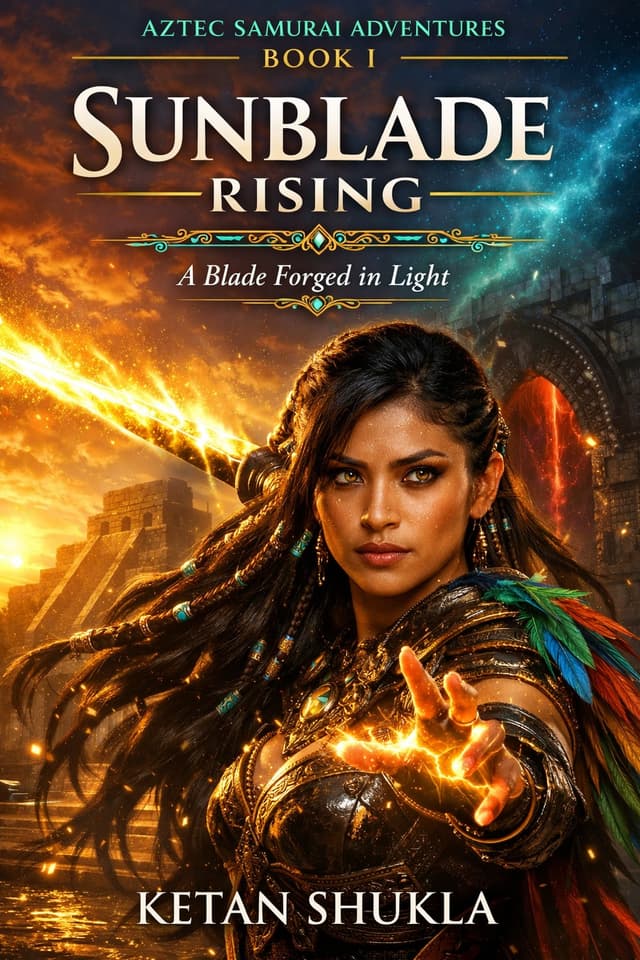
Book 1: Sunblade Rising — produced from the 2,800-word creative brief shown here
Prompt Section Color Key
Is My Book Cover Copyrightable?
The Current Legal Position
The US Copyright Office has said that the copyrightability of AI-assisted works depends on how much human creative control shaped the final result. Works created with minimal human input may not qualify. Works where a human author exercised substantial creative direction, selection, and arrangement do qualify for protection.
Where Your Cover Falls on That Spectrum
- Original character design — characters based on your descriptions, your story, and your vision
- 2,000-3,000 words of specific creative direction per image — hundreds of individual creative decisions, all documented
- Selection and curation from multiple generated candidates
- Professional compositing, color grading, and typography — additional layers of human creative work
- Series-level visual architecture — coordinated design across all covers
For context: a traditional publishing house art director typically provides 200-500 words of creative direction to a commissioned illustrator. My creative briefs contain 5-10 times more specific creative direction than the industry standard.
What This Means for You
Your book cover is a professionally produced visual asset created under extensive human creative direction. The AI is a production tool that executes that vision, similar to how a camera executes a photographer's vision or how digital brushes execute a digital painter's vision.
There is no legal barrier to publishing and selling books with AI-assisted cover art on Amazon, Apple Books, IngramSpark, or any other current platform.
Copyright Registration
- Register the book as a whole work — text, cover, and layout together. The selection, coordination, and arrangement is clearly human-authored.
- Disclose AI assistance if the registration form asks about it. Transparency is always the right approach.
- Your text is fully copyrightable regardless of the cover art — your written work is 100% human-authored and protected.
Will I Get Into Legal Trouble?
What We're NOT Doing
- ✕Copying existing copyrighted artwork or real people's likenesses
- ✕Using generic, minimal prompts and selling raw AI outputs
- ✕Hiding the use of AI tools from clients or platforms
- ✕Claiming images were hand-painted or traditionally illustrated
What We ARE Doing
- Creating original character designs based on your unique story
- Writing thousands of words of specific creative direction
- Selecting, refining, and professionally finishing every deliverable
- Being fully transparent about tools and process
- Complying with all applicable platform requirements and policies
No current law prohibits the commercial use of AI-assisted images created with this level of human creative direction. Amazon, Apple, IngramSpark, and all major publishing platforms accept AI-assisted cover art.
My Guarantee to You
Full Transparency
I will always tell you exactly what tools I use and how I use them. No surprises, no hidden processes.
Commercial Viability
Every deliverable will be suitable for commercial publication on all major platforms. If any platform ever rejects a cover due to AI-related policy changes, I will remake it at no additional cost.
Professional Quality
Your covers will be indistinguishable in quality from traditionally commissioned artwork — production-ready, properly formatted, and optimized for every platform.
Creative Ownership
The creative vision behind your covers — your characters, your world, your story — belongs to you. The detailed creative briefs are based on your intellectual property.
Written Documentation
You will receive a copy of the creative brief used to produce each cover — a complete written record that strengthens your copyright position.
Ongoing Support
If copyright law or platform policies change in the future, I will work with you to ensure your covers remain compliant and commercially viable.
Why This Approach Benefits You
Cost Efficiency
Traditional commissioned cover art costs $500-$2,000+ per book. My workflow delivers equal or superior quality at a more accessible price point, making professional-grade cover art available to independent authors.
Speed
Traditional cover commissions take 4-8 weeks. My workflow delivers finished covers significantly faster without sacrificing quality, getting your book to market sooner.
Precision
I can explore far more creative options than a traditional illustrator working within a fixed revision budget. Different color palettes, poses, or moods can be produced rapidly.
Consistency
For series authors, my detailed brief system ensures characters look consistent across every cover, with a unified, professional visual identity.
Ready to Get Started?
I welcome any questions about this process. Transparency is the foundation of how I work, and I'd rather you ask now than wonder later. There are no bad questions when it comes to understanding how your book's visual identity is being created.
Metronagon Media — Ketan Shukla
Professional Book Cover Design & Series Branding